Sunday, November 27, 2005

The Unapproachable Christopher Lloyd

I love checking out my library’s new book section. Last week I discovered Succession Planting for Year-round Pleasure, a fantastic book by Christopher Lloyd. The photos are among the most beautiful I have ever seen, and I give this book my highest honors. But perhaps it deserves some demerit on the grounds of impracticality or even depressing unattainability.

For one thing, Lloyd’s long border at his estate at Great Dixter is 200 feet by 15 feet, so many of the effects which he finds practical are not possible in any garden likely to be owned by the bourgeoisie. Further, he gardens in England in perhaps the equivalent to Zone 8. Despite this, he is always looking to push the limits of hardiness with exotic plants. And outside of Britain and coastal Oregon and Washington, there is virtually nowhere in the English-speaking world where the winters are so mild, and yet the summers are not too hot for many of his plants.

So taken altogether, in any combination of 3 plants you might consider, it’s a safe bet that 1 of them either can’t be grown in your location, or will require extraordinary levels of coddling to get through the winter. At some level there’s nothing wrong with that; who hasn’t at least considered growing Dahlias or Gladioli, which must be dug up, but can then be stored in most basements? However, his planting schemes are more labor intensive than this. The semi-hardy and tropical plants he loves must be dug up, or have cuttings taken, and many are wintered under glass; to do this for all of his many varied plants, he apparently has at least 3 different temperatures in his greenhouses or cold frames.

Normal (i.e., not superhuman) gardeners use biennials and short-lived perennials (the ones which seed themselves to death) such as Lupines, many Dianthus, Digitalis (foxglove) and Lychnis coronaria, as relatively easy self-sowers, performing enough dead-heading to keep seedlings to a modest level, and hopefully to keep the mother plant alive as well. For Lloyd and his head gardener, Fergus Garrett, the chosen method for all of these but the Lychnis (rose campion) is generally to sow seeds in summer, pot them up and put in a cold frame in October, bed out the next April or May, then rip out the plants as soon as their blooms have faded. Naturally his Lupines make mine look diseased. Damn him to hell and all that. For fuzzy-leaved Verbascums, which he winters in their final positions, he actually suspends a plate of glass over their crowns to keep them dry so they don’t rot!

All that said, his plant combinations are exquisite, and many of them are obtainable by most gardeners in temperate climates. More important, the principles he espouses, the color combinations, and the methods of succession among broad types of plants, are all transferable to less intensive methods, or to other plants which are more practical for your situation. Further, I defy anyone to read this book without discovering several new plants he will plan to try out. I am made newly aware especially of several with true- and deep-blue flowers. Buy or borrow this book, but also consider his older books, The Adventurous Gardener and The Well-Tempered Garden. They have essentially no illustrations, but a wealth of cultural information and design ideas and critiques of many plants and cultivars.

The Adventurous Gardener

The Adventurous Gardener, which I obtained for $4.98 in the bargain book section at New England Mobile Bookstore, has long graced my shelves. It provides a brilliant gardener's take on any number of practical, as well as aesthetic, judgments. The first 11 chapters concern maintenance and propagation, such as "Unusual Ways with Rose Cuttings," “Maintaining Mature Hedging,” and "Some Reactions to Cutting Back" (which covers the results of radical pruning on scores of genuses of shrubs and trees).

The next 8 chapters cover trees and shrubs, Lloyd’s experience and opinions of hundreds of species and cultivars, and the best ways, culturally and aesthetically, to use them in the garden. The rest of the book covers a variety of herbaceous plants, design concepts, the theories of Gertrude Jekyll, “Planning a Border,” you name it. Of course, the book, at 250 pages, is not comprehensive. For that matter, Lloyd’s The Well-Tempered Garden is in a sense basically the same book, except that there is very little overlap. Each is a series of essays which stands on its own. (Similarly, the estate of the late Henry Mitchell has 3 such books out, made up of his newspaper gardening columns; but Mitchell’s columns are shorter and more about literary style than detail, and his 3 books overlap each other considerably.)

This book’s greatest weakness: it only has 18 low-resolution black & white photos. These are in the book's center, and do little to illustrate the text. So in order to follow many of the chapters, which concern specific varieties of, say, crabapple trees, or concern combinations of plants, you will have to have the A-Z Encyclopedia of Garden Plants or a similar reference at hand. That said, this keeps the book small and dirt cheap (as little as a dollar used via Amazon). I suppose I could, for lack of hundreds of glossy color photos, rate the book less than the perfect 5 stars, but I can’t see criticizing a book for not being what it is not, especially when it is so good at being what it is.

Friday, October 07, 2005


Not bad for October. (No frost yet!) Posted by Picasa

A Longer Lasting Rudbeckia?

The above photo shows part of my double border (photo taken 10/7/05). Obviously, the plants are past their peak. But note that Rudbeckia 'Irish Eyes' (near left) is still looking relatively fresh, while Rudbeckia 'Goldsturm' (just to the right of 'Irish Eyes') is now basically just brown "cones" with all petals fallen or drooping straight downward. Now, 'Goldsturm' is a great plant, and I like its slightly golden tone (and brown centers) slightly more than the purer yellow petals and greenish centers of 'Irish Eyes,' but the 'Irish Eyes' habit of blooming at least three weeks later into the fall is worth something.

Also, since everyone has 'Goldsturm,' I wouldn't want to overuse that variety. Fortunately the two plants go together well, so I'll keep 'em both. Another good thing about 'Irish Eyes' (and Rudbeckia and composites in general) is that it can flower well even in its first year from seed, which is unusual at least for noncomposite perennials. I started them indoors on 2/27/05 and planted out on 4/26/05, with no coddling.

Saturday, September 17, 2005


My trellis, with Ipomeia 'Scarlet O'Hara.' Posted by Picasa

Tuesday, September 13, 2005

Head in the Sun, Roots in the Shade

It’s not often that gardening makes me feel stupid.

Killing plants doesn’t. Plants die. And generally when I’ve killed them I had recognized that I was taking a risk, such as putting a silver-leaved plant in moisture-retentive soil in part shade, because I liked the way it looked there more than any other available spot. (On that score, Lychnis coronaria is far more tolerant of shade and moisture than is Lavandula angustifolia ‘Munstead.’)

But last week, I found myself wondering how I could possibly have failed to understand the needs of vines. It’s often said of Clematis, among many vines, that they like their “head in the sun and roots in the shade.” This would seem to fit their natural orientation climbing over shrubs or trees. But isn’t the same true of the shrubs or trees, and even herbaceous border plants, as well?

These plants also generally have their heads in the sun, and their roots are also shaded, by themselves and, in a closely planted bed, their neighbors, yet something different must be happening with vines to lead to the “head in the sun and roots in the shade” prescription – assuming it isn’t a bunch of bovine feces.

Although I’m not arrogant enough to think that such a common prescription could be entirely wrong, the bovine feces hypothesis is always worth consideration. For one thing, roots clearly don’t sense the sunlight itself. They sense temperature and moisture levels. Naturally, a good layer of mulch can, as much as shade from above-ground growth, keep the sun’s rays from raising soil temperatures and evaporating near-surface moisture. Dry soil will be hotter than moist soil. And the application of (cold) water from ground sources and deep reservoirs (i.e., most any private or municipal water supply) will directly and rapidly cool an overly warm bed of soil.

Of course, the questions remain whether one can add sufficient water to cool the soil, without damaging a plant not adapted to bogs, or whether soil in New England will ever be both quite wet and too hot for a “normal” plant – or just about any plant, given that the silver-toned Mediterranean plants which like dry conditions are also resistant to any heat that New England can dish out.

Getting back to my “D’oh!” moment of last week. The morning glory (Ipomeia ‘Scarlet O’Hara’) vines have run well over the top of my trellis (previous post). Whenever I’ve watered, I’ve see that they’re dry (by poking a finger through the mulch) and added as much water to them as I do to just about any of my herbaceous plants (10 seconds from a handheld shower head nozzle at a non-blasting but considerable flow). This seems like a lot of water, given that the 10 plants are a foot apart and seem to share each others’ water, are well mulched with cedar chips, are clear overhead to rain water, and are really only getting half sun. But while the plants have grown tall, and flowered reasonably well, they’ve still always seemed a bit peaked. So this last time, I checked the soil again a few minutes after I watered. Bone dry! I repeated this process 6 times (pausing for soak-in) before achieving, I think, the average moisture level my other plants would get from one pass.

*And then I realized... like I was shot with a diamond bullet right through my forehead, that this scarcely more than 10 square feet of planted bed was supporting close to 100 square feet of foliage – 100 square feet of plant matter which was transpiring, in the face of the sun, perhaps 10 times more water than if the bed were planted with modest-height border perennials.

Many vines like sun. And unlike most sun-loving plants, perhaps all of them will benefit from shading of the soil around their roots. But the crystalline, pure truth of the vine’s essence and needs is that it sucks up a lot of water because it is so tall and skinny and covered with foliage along its height. In contrast, trees and tall self-standing perennials keep most of their foliage on the top and side edges of the volume they “fill.” (Interior foliage, if it is not sloughed off, is largely shaded.) As such, their water needs do not go up linearly (or much at all) with their height.

On the whole, the printed sources I’ve checked speak of a need for average soil moisture for morning glories, or say “keep well watered until established.” I can’t disagree, but I am pretty sure that maintaining an average level of soil moisture will always require an above-average level of watering, for morning glories and probably for virtually any vine.

*Kurtz, 1979

Monday, June 20, 2005


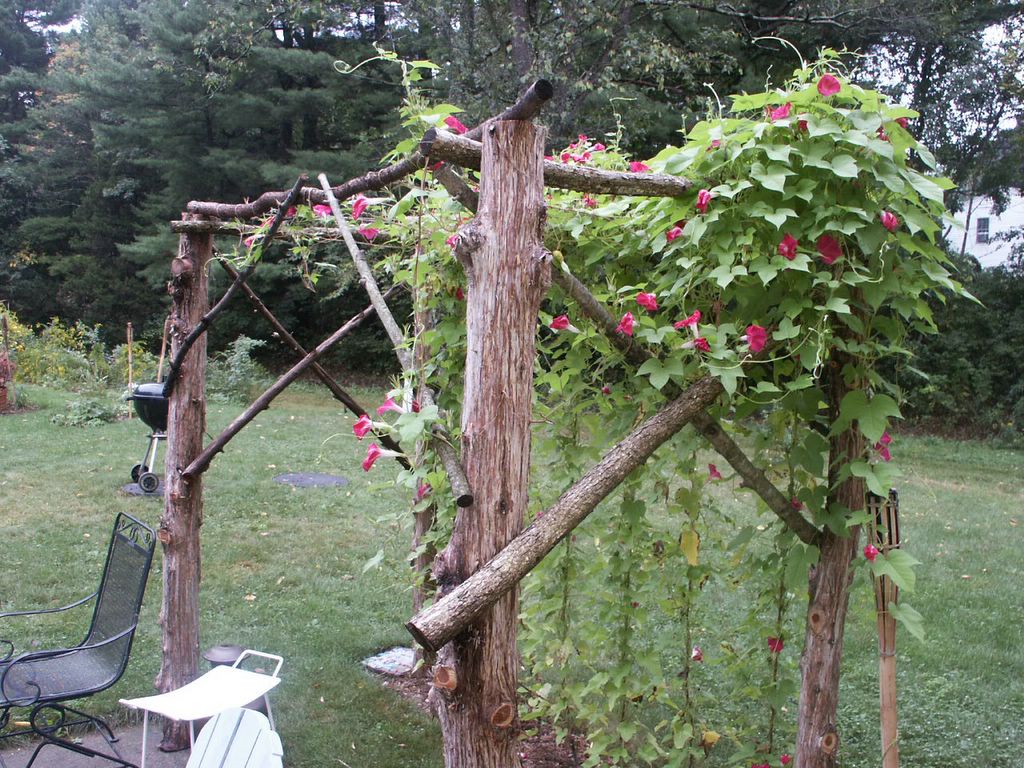
My newly completed trellis (details below). Posted by Hello

Trellis, Anyone?

I’ve been largely out of commission in the garden for the past two weeks, due to jury duty and personal matters. But on Saturday (June 18) I built this 7 foot tall by 9 foot wide rustic cedar trellis. It took all day, the process including cutting with a gasoline chainsaw and electric circular saw, digging, elevating and securing all pieces with stainless steel #10 2½” screws. (Tree felling and design had been done earlier.)

The upright posts are Juniperus virginiana (Eastern red cedar), with horizontal and diagonal stiffening pieces of the same wood or of hardwoods, as I didn’t have a lot of long, straight, smaller diameter cedar. The rear posts are set 12” in the ground, on top of 4” of rocks and sand, the remaining 12” hole then filled with 8” of sand and 4” of soil. I suspect the posts will last for 8 to 10 years, while some of the hardwood cross-pieces may have to be replaced in as little as 2 years due to rot. It’s not much work to replace cross-pieces one at a time; the difficult task is setting up posts and holding them upright while securing them.

I have yet to run vertical strings for the morning glories (Ipomeia ‘Scarlet O’Hara,’ visible in the center of the soil bed, and now just 1 foot tall) to climb, and I will also be adding some smaller pieces of wood, or horizontal wires, for various plants to climb, the exact use of which depends on what other plants I end up adding.

Given the yellow and white house, the existing morning glories, and my desire for roses, I think I’ll have to stick with red to orange or red to pink flowers.

I want to have at least one rose, given the site probably a climber like the red 7-petaled Altissimo, or the nonremontant red very double ‘Chevy Chase’, both of which Peter Schneider on Roses says are good choices for half shade. (This is an excellent book, probably the best of the “Burpee Expert Gardener” series; it consists of Schneider’s favorite 400 or so rose cultivars among the 1,400 he boasts of having grown, with many photographs and some broader cultural tips and information on classes of rose.)

For the other plants I am undecided. A clematis would be nice, especially a later bloomer that can be pruned in the spring with the rose.

Ideally, at least one of the plants will grow long and full enough to cover the top of the trellis and shade the chairs below from the mid-day sun behind them. And some broad-leaf evergreen foliage would be nice in the winter, although I think that would mean including a plant without blooms as flamboyant as rose or clematis, so I wouldn’t want to overdo the evergreens, or have to keep fighting to keep an invasive ivy off of my flowering plants.

Thursday, June 16, 2005


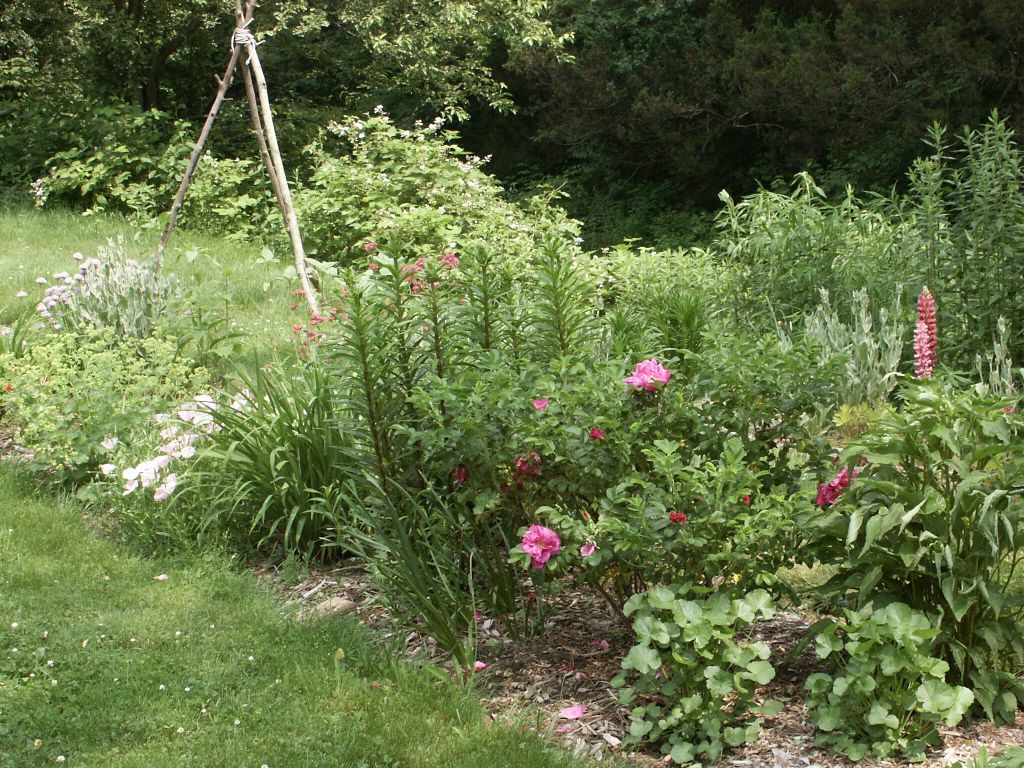
Blooming rugosa Moje Hammarberg, among other plants in my long bed (see text below). Posted by Hello

Monday, June 06, 2005

Moje Hammarberg and his neighbors

Here’s a section of the middle of my long bed, which is finally showing some promise for the season.

Near the right we see ‘Moje Hammarberg,’ whose first bloom opened 6/6/05. Its loosely double, bright saturated purplish-pink flowers are sweetly scented, and come early and throughout the season. (This year everything is running relatively late; I haven’t seen other cultivated roses blooming to date.) This rose grows 3 or 4 feet tall and at least as wide. Like most rugosas, its wrinkly leaves are extremely healthy, its stems are extremely prickly, it will have large hips, and it’s hardy down to Zone 3 or 4 (it was introduced in Sweden in 1931). Last year I wasn’t blown away by the number of its blooms, but that was its first season, and I purchased and planted it rather late (6/20/05, consequently it was just $10 outside the Building 19 on routes 27 and 9 – their non-rugosas were looking pretty sick by that time). The only care I gave it: planted in a well-dug bed, watered when droughty, and knocked off Japanese beetles (tools: a plastic spatula and a soapy pail of water). While powdery mildew was pervasive among nearby roses and brambles, this plant never showed a sign of it, or of any stress. I heartily recommend it, especially to gardeners who think roses are too difficult.

Next from the right: Narcissus leaves (dead-headed).

Middle: Lillium ‘America is putting up quite a few big, healthy looking stalks. In my previous post I covered its scarlet lily beetle infestation. As it happens, since my one spraying of Pyrethrin, I have only seen 1 or 2 beetles per day, so I’m hoping my daily inspection and squashing regime will keep the plants healthy without resort to more radical measures.

To the left, behind a tuft of daylily foliage and the Lillium, Centranthus rubra (Jupiter’s Beard, aka Red Valerian, among other names). You can see the first small blooms just starting on top of the Centranthus. This plant handles extremes of temperature, soil and moisture – despite its Mediterranean origins and reputed preference for dry, alkaline conditions, it proved healthy and vigorous for me last year (while my Verbascum was putrefying), with a long season of bloom. Individually, its clusters of small flowers don’t compare to, say, roses, but the plant will soon be much more flamboyant than pictured here. I don’t know why it’s not more popular, unless it’s because it’s too easy to grow for bragging rights, and gets large and flops a bit on its neighbors – that doesn’t bother me if a plant is easy to shear back (no picky pruning regimen, prickly thorns or overly invasive roots). Centranthus is also available in lighter pinks and white. It is featured in the book Antique Flowers, by Katherine Whiteside (1988), a great source for discovering old-fashioned and relatively neglected species.

And to the left of the daylily foliage, a pale pink Oenothera (evening primrose). Or actually, a number of seedlings from the Oenothera, as there did not appear to be a returning (perennial) stalk. These beautiful pinkish mauve flowers appear to glow brighter-than-white in low light conditions, and despite the species' common name, appear throughout the day.And behind Oenothera: Alchemilla mollis (Lady's Mantle), and pink-flowering Allium (chive). All three of these plants are easy and healthy, although often reported to be somewhat invasive I have only found the Oenothera to be so, and its seedlings are pretty easy to identify and pull up if necessary (unlike some invasive plants which spread by runners). The chive is of course tasty with scrambled eggs.

Back Row near right: Lupines and Lychnis coronaria (rose campion, not yet flowering).

Monday, May 23, 2005

Killing the Red Lily Beetle

I have the dreaded red lily beetle (aka scarlet lily beetle). Yesterday I saw several adult beetles living on the Fritillaria imperialis in my bulb bed, as well as on the Lillium ‘America’ in my long bed, but not (yet) on the shorter Lillium ‘Stargazer’ in the same bed about 15 feet away.

So I sprayed Lillium ‘America’ with Schultz House & Garden Insect Spray (0.02% Pyrethrin) yesterday. The product claims to work on beetles, and today I saw no beetles there, although they were still on the unsprayed F. imperalis. But I have seen reports of very limited effect from this organic pesticide, and it’s close to impossible to spray-cover all parts of this Lily plant, whose leaves are still quite curled up, especially if you want to avoid overspray.

I do not want to use far more toxic pesticides such as imidacloprid. Instead, I have a more radical plan, or experiment, in mind. That is to use fumigation (i.e., gas, within an enclosure). In general, fumigants are considered too dangerous for amateur use. But I would use either cigarette smoke or carbon dioxide to kill the beetles, and I can’t see fearing either gas (well, smoke is more like an aerosol), especially when used outside, and within an enclosure.

Basically, I could upend a container like a trash can – preferably clear – on the plants. This container would have two holes in it, one connected to a hose, the other with a flap or other one-way valve on it. Since smoke (and carbon dioxide) is heavier than air, I will pump smoke into the lower hose, with air to vent out the top until the container is full of smoke. The cigarette will be held within a pipe-like mechanism, surrounded by a glass cylinder, so I can watch the cigarette burn down as I pump air into the mechanism, through the hot cigarette, and into a narrower tube placed on the filter. (I may remove the filter; why reduce the toxins?)

Of course, I do not know if this will work – ideally, kill adults, eggs and larvae. I have read of a high-school science experiment / propaganda, where tobacco smoke is shown to kill flies, which are unharmed by a similar amount of paper smoke. Also, nicotine has long been used as an insecticidal powder, and is in the tobacco plant precisely as a systemic pesticide, as are most plant toxins. It’s just a question of dose and duration, relative to the particular susceptibility of the Lily Beetle.

Provided the beetle infestation survives the pyrethrin – which seems likely – I think I will have to head out to a hardware store, or maybe a head shop, if they still have those, soon.

Whether tobacco works or not, I may also try carbon dioxide. It’s easy to get 10 to 20 oz. tanks of pressurized liquid CO2 for use in “constant air” paint ball guns (they’re rather smaller than the standard propane tank used by plumbers).

I have not been able to find anything concerning horticultural use of tobacco smoke as an insecticidal fumigant. Does anyone have any experience with such methods, or know of any source concerning the same?