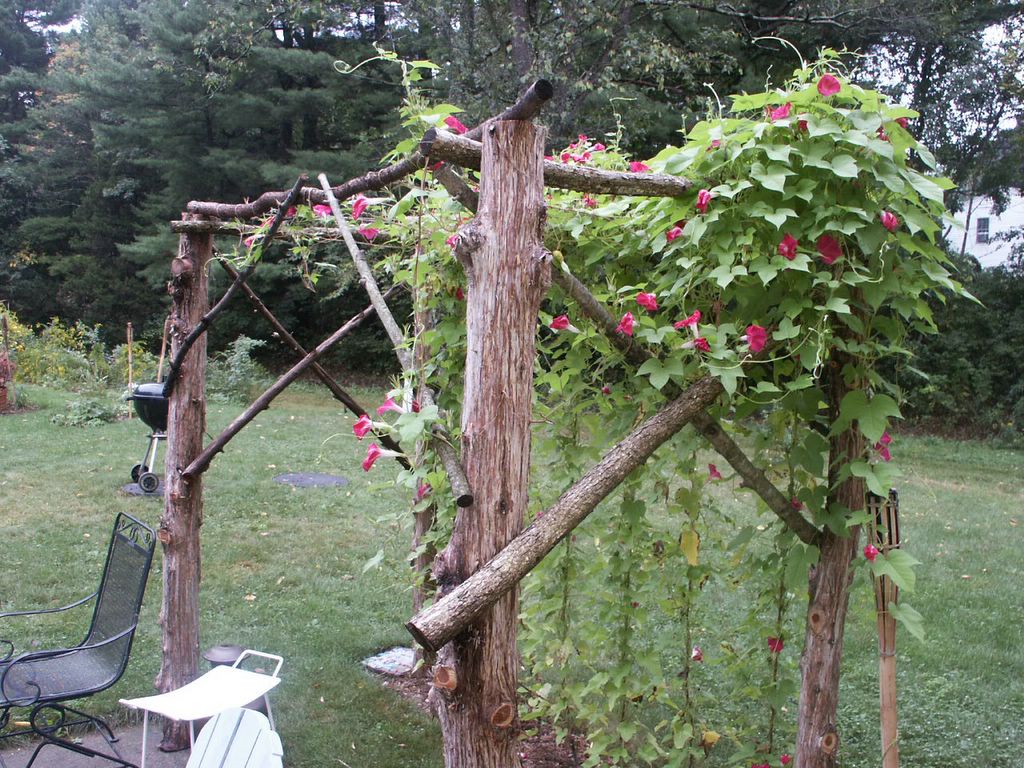
Not bad for October. (No frost yet!)

It’s not often that gardening makes me feel stupid.
Killing plants doesn’t. Plants die. And generally when I’ve killed them I had recognized that I was taking a risk, such as putting a silver-leaved plant in moisture-retentive soil in part shade, because I liked the way it looked there more than any other available spot. (On that score, Lychnis coronaria is far more tolerant of shade and moisture than is Lavandula angustifolia ‘Munstead.’)
But last week, I found myself wondering how I could possibly have failed to understand the needs of vines. It’s often said of Clematis, among many vines, that they like their “head in the sun and roots in the shade.” This would seem to fit their natural orientation climbing over shrubs or trees. But isn’t the same true of the shrubs or trees, and even herbaceous border plants, as well?
These plants also generally have their heads in the sun, and their roots are also shaded, by themselves and, in a closely planted bed, their neighbors, yet something different must be happening with vines to lead to the “head in the sun and roots in the shade” prescription – assuming it isn’t a bunch of bovine feces.
Although I’m not arrogant enough to think that such a common prescription could be entirely wrong, the bovine feces hypothesis is always worth consideration. For one thing, roots clearly don’t sense the sunlight itself. They sense temperature and moisture levels. Naturally, a good layer of mulch can, as much as shade from above-ground growth, keep the sun’s rays from raising soil temperatures and evaporating near-surface moisture. Dry soil will be hotter than moist soil. And the application of (cold) water from ground sources and deep reservoirs (i.e., most any private or municipal water supply) will directly and rapidly cool an overly warm bed of soil.
Of course, the questions remain whether one can add sufficient water to cool the soil, without damaging a plant not adapted to bogs, or whether soil in New England will ever be both quite wet and too hot for a “normal” plant – or just about any plant, given that the silver-toned Mediterranean plants which like dry conditions are also resistant to any heat that New England can dish out.
Getting back to my “D’oh!” moment of last week. The morning glory (Ipomeia ‘Scarlet O’Hara’) vines have run well over the top of my trellis (previous post). Whenever I’ve watered, I’ve see that they’re dry (by poking a finger through the mulch) and added as much water to them as I do to just about any of my herbaceous plants (10 seconds from a handheld shower head nozzle at a non-blasting but considerable flow). This seems like a lot of water, given that the 10 plants are a foot apart and seem to share each others’ water, are well mulched with cedar chips, are clear overhead to rain water, and are really only getting half sun. But while the plants have grown tall, and flowered reasonably well, they’ve still always seemed a bit peaked. So this last time, I checked the soil again a few minutes after I watered. Bone dry! I repeated this process 6 times (pausing for soak-in) before achieving, I think, the average moisture level my other plants would get from one pass.
*And then I realized... like I was shot with a diamond bullet right through my forehead, that this scarcely more than 10 square feet of planted bed was supporting close to 100 square feet of foliage – 100 square feet of plant matter which was transpiring, in the face of the sun, perhaps 10 times more water than if the bed were planted with modest-height border perennials.
Many vines like sun. And unlike most sun-loving plants, perhaps all of them will benefit from shading of the soil around their roots. But the crystalline, pure truth of the vine’s essence and needs is that it sucks up a lot of water because it is so tall and skinny and covered with foliage along its height. In contrast, trees and tall self-standing perennials keep most of their foliage on the top and side edges of the volume they “fill.” (Interior foliage, if it is not sloughed off, is largely shaded.) As such, their water needs do not go up linearly (or much at all) with their height.
On the whole, the printed sources I’ve checked speak of a need for average soil moisture for morning glories, or say “keep well watered until established.” I can’t disagree, but I am pretty sure that maintaining an average level of soil moisture will always require an above-average level of watering, for morning glories and probably for virtually any vine.
*Kurtz, 1979
I’ve been largely out of commission in the garden for the past two weeks, due to jury duty and personal matters. But on Saturday (June 18) I built this 7 foot tall by 9 foot wide rustic cedar trellis. It took all day, the process including cutting with a gasoline chainsaw and electric circular saw, digging, elevating and securing all pieces with stainless steel #10 2½” screws. (Tree felling and design had been done earlier.)
The upright posts are Juniperus virginiana (Eastern red cedar), with horizontal and diagonal stiffening pieces of the same wood or of hardwoods, as I didn’t have a lot of long, straight, smaller diameter cedar. The rear posts are set 12” in the ground, on top of 4” of rocks and sand, the remaining 12” hole then filled with 8” of sand and 4” of soil. I suspect the posts will last for 8 to 10 years, while some of the hardwood cross-pieces may have to be replaced in as little as 2 years due to rot. It’s not much work to replace cross-pieces one at a time; the difficult task is setting up posts and holding them upright while securing them.
I have yet to run vertical strings for the morning glories (Ipomeia ‘Scarlet O’Hara,’ visible in the center of the soil bed, and now just 1 foot tall) to climb, and I will also be adding some smaller pieces of wood, or horizontal wires, for various plants to climb, the exact use of which depends on what other plants I end up adding.
Given the yellow and white house, the existing morning glories, and my desire for roses, I think I’ll have to stick with red to orange or red to pink flowers.
I want to have at least one rose, given the site probably a climber like the red 7-petaled Altissimo, or the nonremontant red very double ‘Chevy Chase’, both of which Peter Schneider on Roses says are good choices for half shade. (This is an excellent book, probably the best of the “Burpee Expert Gardener” series; it consists of Schneider’s favorite 400 or so rose cultivars among the 1,400 he boasts of having grown, with many photographs and some broader cultural tips and information on classes of rose.)
For the other plants I am undecided. A clematis would be nice, especially a later bloomer that can be pruned in the spring with the rose.
Ideally, at least one of the plants will grow long and full enough to cover the top of the trellis and shade the chairs below from the mid-day sun behind them. And some broad-leaf evergreen foliage would be nice in the winter, although I think that would mean including a plant without blooms as flamboyant as rose or clematis, so I wouldn’t want to overdo the evergreens, or have to keep fighting to keep an invasive ivy off of my flowering plants.
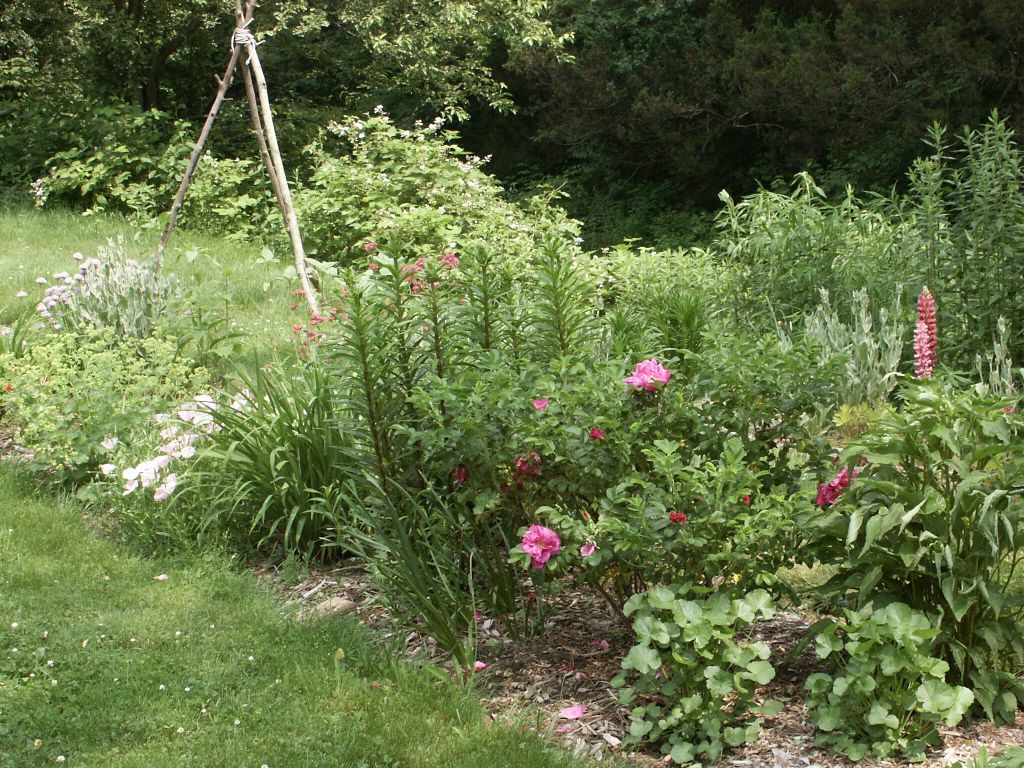
Here’s a section of the middle of my long bed, which is finally showing some promise for the season.
Near the right we see ‘Moje Hammarberg,’ whose first bloom opened 6/6/05. Its loosely double, bright saturated purplish-pink flowers are sweetly scented, and come early and throughout the season. (This year everything is running relatively late; I haven’t seen other cultivated roses blooming to date.) This rose grows 3 or 4 feet tall and at least as wide. Like most rugosas, its wrinkly leaves are extremely healthy, its stems are extremely prickly, it will have large hips, and it’s hardy down to Zone 3 or 4 (it was introduced in
Next from the right: Narcissus leaves (dead-headed).
Middle: Lillium ‘
To the left, behind a tuft of daylily foliage and the Lillium, Centranthus rubra (Jupiter’s Beard, aka Red Valerian, among other names). You can see the first small blooms just starting on top of the Centranthus. This plant handles extremes of temperature, soil and moisture – despite its Mediterranean origins and reputed preference for dry, alkaline conditions, it proved healthy and vigorous for me last year (while my Verbascum was putrefying), with a long season of bloom. Individually, its clusters of small flowers don’t compare to, say, roses, but the plant will soon be much more flamboyant than pictured here. I don’t know why it’s not more popular, unless it’s because it’s too easy to grow for bragging rights, and gets large and flops a bit on its neighbors – that doesn’t bother me if a plant is easy to shear back (no picky pruning regimen, prickly thorns or overly invasive roots). Centranthus is also available in lighter pinks and white. It is featured in the book Antique Flowers, by Katherine Whiteside (1988), a great source for discovering old-fashioned and relatively neglected species.
And to the left of the daylily foliage, a pale pink Oenothera (evening primrose). Or actually, a number of seedlings from the Oenothera, as there did not appear to be a returning (perennial) stalk. These beautiful pinkish mauve flowers appear to glow brighter-than-white in low light conditions, and despite the species' common name, appear throughout the day.And behind Oenothera: Alchemilla mollis (Lady's Mantle), and pink-flowering Allium (chive). All three of these plants are easy and healthy, although often reported to be somewhat invasive I have only found the Oenothera to be so, and its seedlings are pretty easy to identify and pull up if necessary (unlike some invasive plants which spread by runners). The chive is of course tasty with scrambled eggs.
Back Row near right: Lupines and Lychnis coronaria (rose campion, not yet flowering).
So I sprayed Lillium ‘
I do not want to use far more toxic pesticides such as imidacloprid. Instead, I have a more radical plan, or experiment, in mind. That is to use fumigation (i.e., gas, within an enclosure). In general, fumigants are considered too dangerous for amateur use. But I would use either cigarette smoke or carbon dioxide to kill the beetles, and I can’t see fearing either gas (well, smoke is more like an aerosol), especially when used outside, and within an enclosure.
Basically, I could upend a container like a trash can – preferably clear – on the plants. This container would have two holes in it, one connected to a hose, the other with a flap or other one-way valve on it. Since smoke (and carbon dioxide) is heavier than air, I will pump smoke into the lower hose, with air to vent out the top until the container is full of smoke. The cigarette will be held within a pipe-like mechanism, surrounded by a glass cylinder, so I can watch the cigarette burn down as I pump air into the mechanism, through the hot cigarette, and into a narrower tube placed on the filter. (I may remove the filter; why reduce the toxins?)
Of course, I do not know if this will work – ideally, kill adults, eggs and larvae. I have read of a high-school science experiment / propaganda, where tobacco smoke is shown to kill flies, which are unharmed by a similar amount of paper smoke. Also, nicotine has long been used as an insecticidal powder, and is in the tobacco plant precisely as a systemic pesticide, as are most plant toxins. It’s just a question of dose and duration, relative to the particular susceptibility of the Lily Beetle.
Provided the beetle infestation survives the pyrethrin – which seems likely – I think I will have to head out to a hardware store, or maybe a head shop, if they still have those, soon.
Whether tobacco works or not, I may also try carbon dioxide. It’s easy to get 10 to 20 oz. tanks of pressurized liquid CO2 for use in “constant air” paint ball guns (they’re rather smaller than the standard propane tank used by plumbers).
I have not been able to find anything concerning horticultural use of tobacco smoke as an insecticidal fumigant. Does anyone have any experience with such methods, or know of any source concerning the same?